The O/0 Receiver-Field Hypothesis: one substrate, many tuned perspectives
Version 1.0.0. Date: 2026-11-11. New theoretical model and prospective computational study.
Status: RECEIVER_PATTERN_SUPPORTED_IN_MODEL. Physical validation: NONE. Independent peer review: NONE.
Central hypothesis
Awareness is intrinsic to a persistent substrate; minds are localized, frequency-selective receivers that transform and report aspects of that substrate. This is the user's clarified O/0 hypothesis taken seriously as the starting point for a mathematical theory.
The proposed model gives the carrier its own nonlinear spatial dynamics, gives each local mind 19 heterogeneous internal modes, and couples the two reciprocally. Minds can affect the field; they do not initialize or manufacture it. Four differently tuned minds access four contents of one field. This is a proposed effective model, not a high-fidelity biological brain simulation.
The 64-site lattice and 19 internal modes are chosen model resolutions, not claimed fundamental constants or measured dimensions of human consciousness.
Result
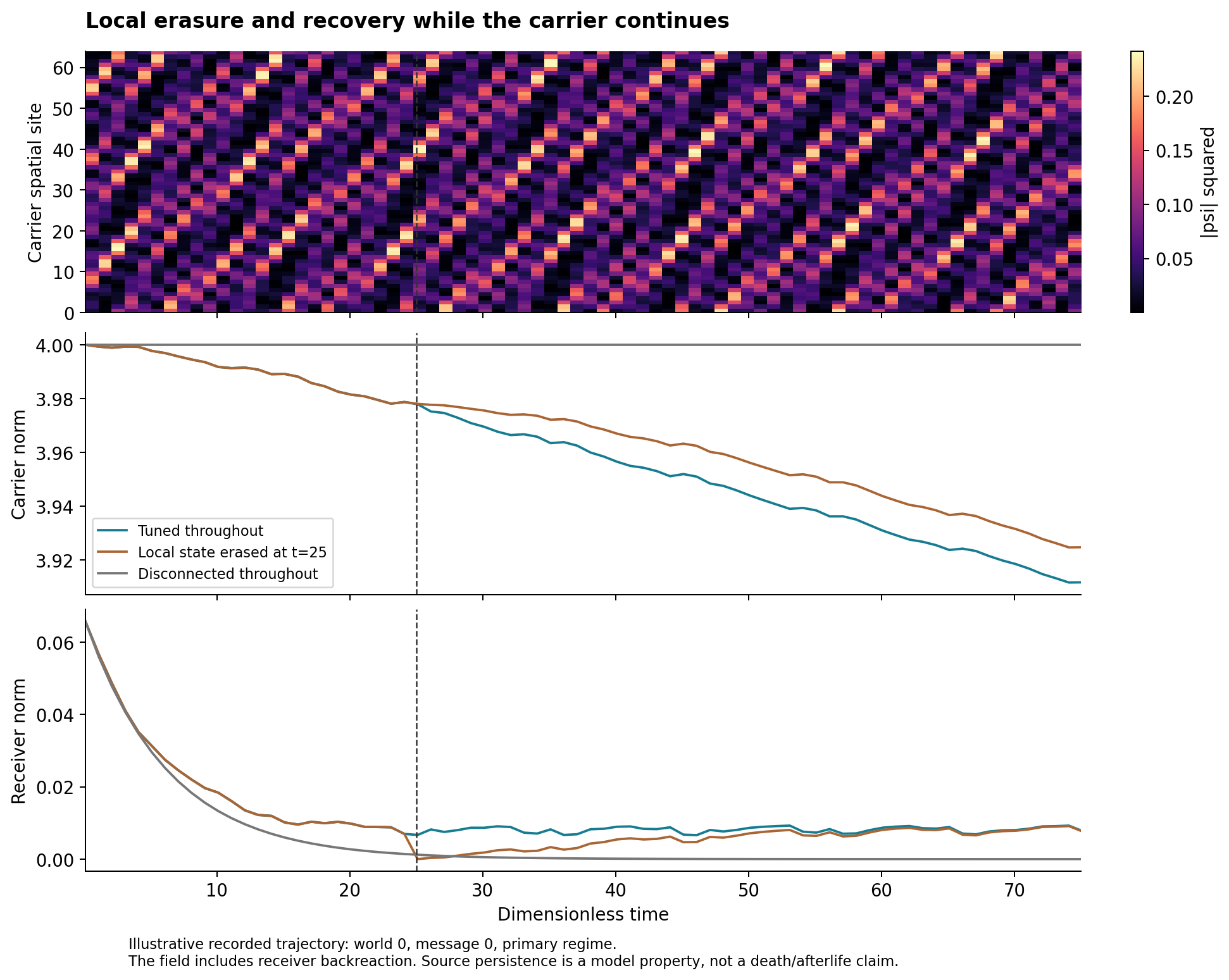
The frozen receiver-pattern criterion is met. The simulated minds recover source content when tuned, lose access when coupling is absent, and reacquire content after local-state erasure or restored tuning. A persistent carrier and temporary local access coexist in this construction.
A successful outcome establishes a constructive receiver architecture and its conditional predictions. The identification of its carrier with awareness remains a postulate awaiting empirical testing.
Equations and mathematical results
The full Hamiltonian, field equations and frozen predictions are in model_and_predictions.md. Detailed derivations are in theorems.md. They establish:
- A nonincreasing combined carrier/receiver norm with an explicit bath and erasure budget, plus bounded finite-dimensional solutions.
- Carrier persistence when receiver coupling is removed, including a real cubic field nonlinearity.
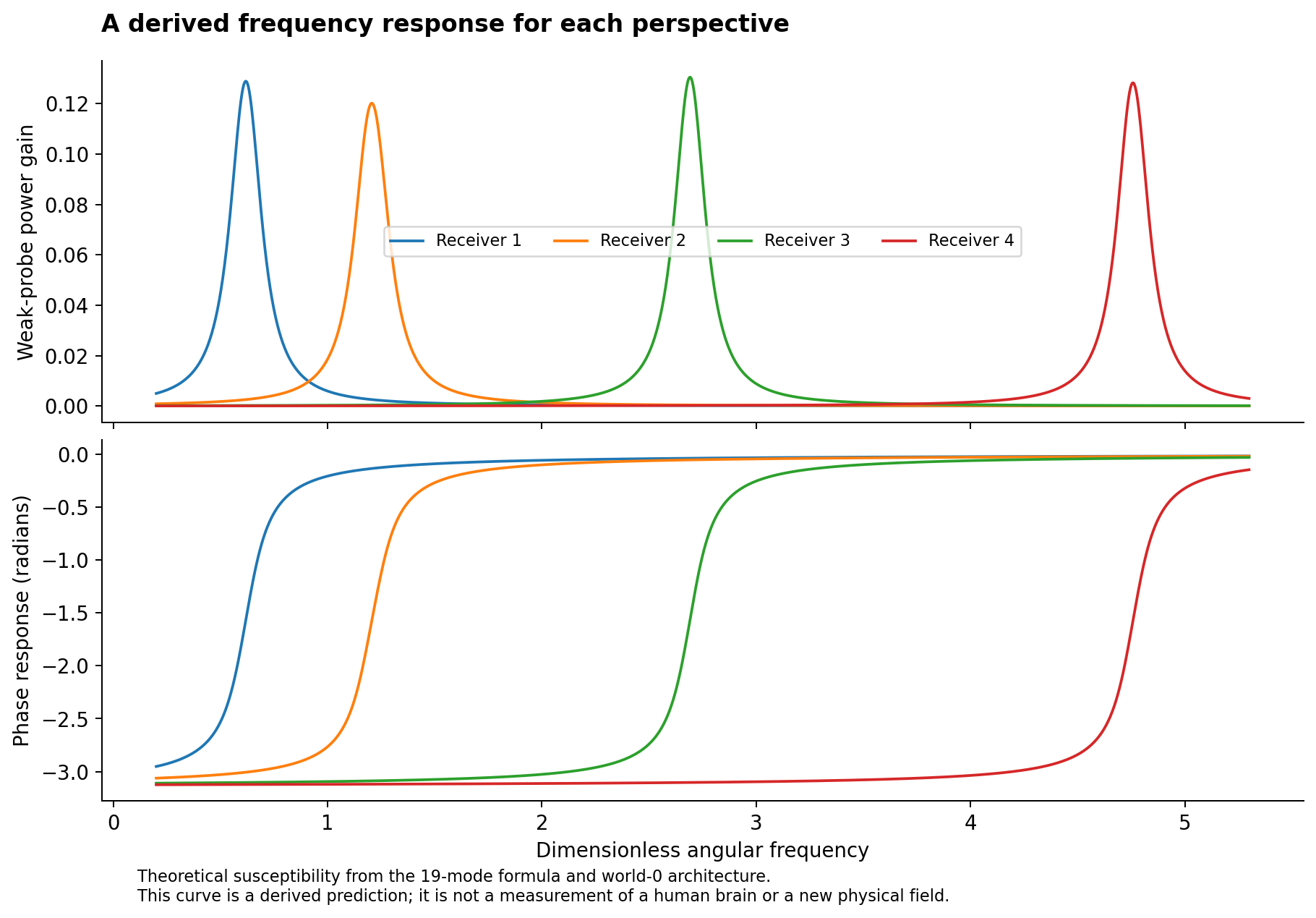
- A complex 19-mode susceptibility determining both gain and phase. Its one-mode limit has a Lorentzian power profile and full width 2*gamma.
- Exponential forgetting of a receiver's initial state under a specified imposed field; a distinct reciprocal self-energy relation accounts for receiver backreaction.
- A discrete norm accounting identity for the implemented field, damping and coupling substeps.
These are proofs about the equations. They do not deduce the equations' awareness interpretation from the simulated numbers. No entropy statistic is labeled measured consciousness.
One integrated experiment
Twelve independently seeded worlds each contain a 64-site periodic field and four 19-mode receivers. There are 3,072 initial message trials, with four randomized phase symbols per message. The same worlds/messages are paired across six intervention branches and two field regimes. Counterfactual branches and the two regimes are not counted as extra independent worlds.
The four-symbol alphabet permits 256 field codewords, so codewords may recur. Balanced label counts also make rows within a partition dependent; uncertainty is assessed across worlds, not by treating all message rows as independent observations.
The primary carrier is linear; the sensitivity carrier has cubic coefficient lambda=0.5. Both include reciprocal coupling, heterogeneous tuning, damping and sensor noise. All six branches start from matched field states and identical local states that contain no message labels. The simulator runs to dimensionless t=75, with interventions at t=25 and dt=0.1. It uses actual integration steps, not a claim to bypass sequential computation.
A fixed decoder learns class centroids from the first 128 messages per world and is evaluated on the remaining 128. Classes are balanced independently in each half. Inputs are only the real and imaginary report channel, with fixed sensor noise. The noise scale was selected before execution from the analytic gain to demonstrate a decodable regime; it is not a measured biological parameter.
Held-out primary results
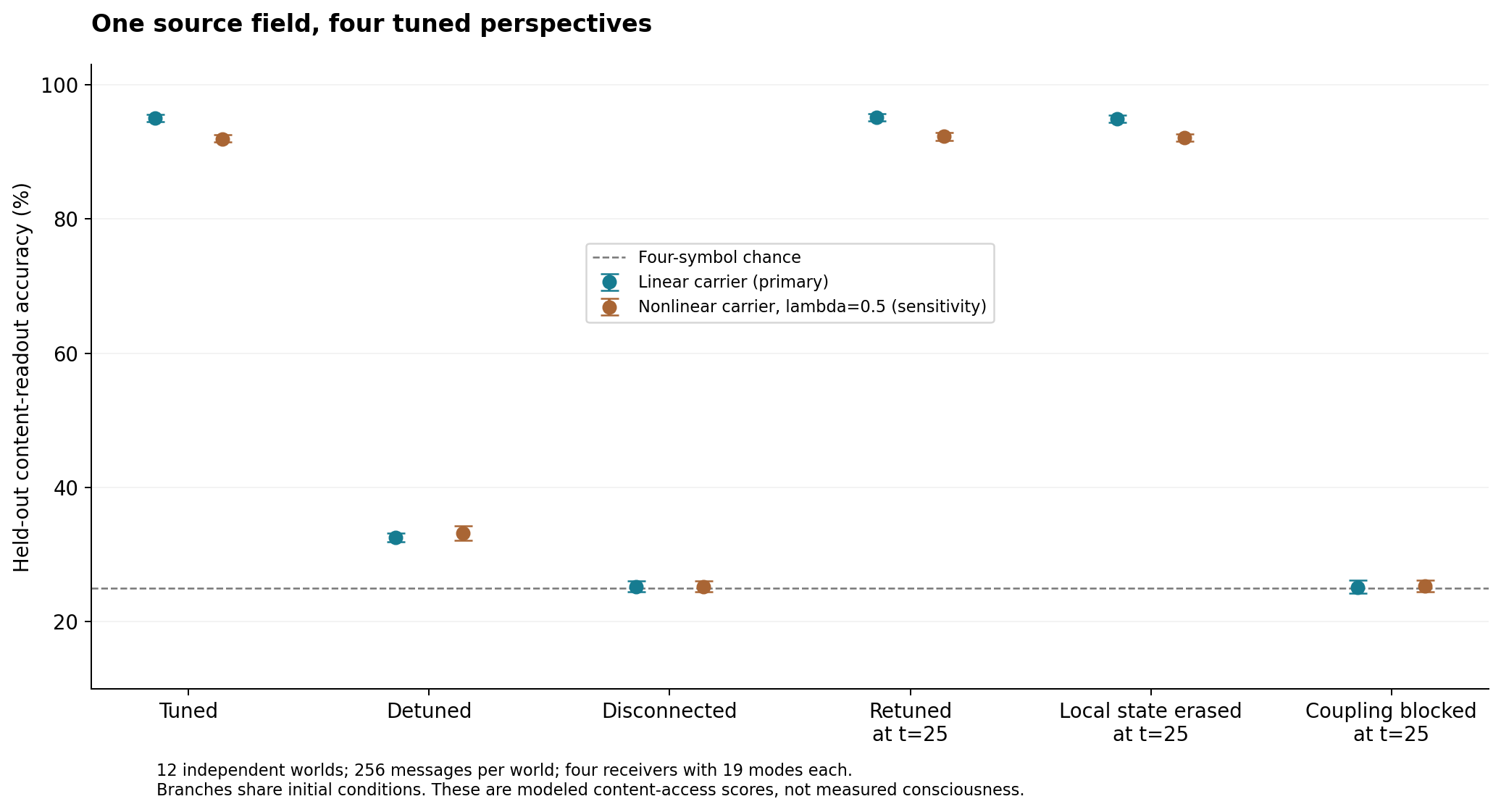
- MATCHED: 95.04% (95% world-bootstrap interval 94.45 to 95.57%).
- DETUNED: 32.50% (95% world-bootstrap interval 31.87 to 33.19%).
- DISCONNECTED: 25.26% (95% world-bootstrap interval 24.48 to 26.04%).
- RETUNED: 95.12% (95% world-bootstrap interval 94.55 to 95.64%).
- ERASED: 94.92% (95% world-bootstrap interval 94.34 to 95.46%).
- BLOCKED_AFTER: 25.15% (95% world-bootstrap interval 24.25 to 26.14%).
Intervals resample the 12 independent worlds 20,000 times. Chance is 25%. These are content-readout scores, not consciousness levels.
Primary criteria:
- matched_access: PASS.
- detuning_gap: PASS.
- disconnected_loses_access: PASS.
- blocked_after_loses_access: PASS.
- retuning_restores: PASS.
- local_erasure_recovers: PASS.
- carrier_persists: PASS.
Nonlinear sensitivity results
- MATCHED: 91.93% (95% world-bootstrap interval 91.41 to 92.48%).
- DETUNED: 33.24% (95% world-bootstrap interval 32.13 to 34.29%).
- DISCONNECTED: 25.26% (95% world-bootstrap interval 24.48 to 26.04%).
- RETUNED: 92.27% (95% world-bootstrap interval 91.72 to 92.85%).
- ERASED: 92.07% (95% world-bootstrap interval 91.57 to 92.61%).
- BLOCKED_AFTER: 25.28% (95% world-bootstrap interval 24.45 to 26.17%).
These results are reported separately and do not change the frozen primary verdict. Nonlinearity can mix source modes and alter which simple tuning settings recover content. A change of operating regime is not automatically interpreted as greater or lesser awareness.
Numerical validation and source persistence
Independent full-matrix-exponential relative error at dt=0.1: 0.00010735758; halving dt improved the error by 4.0611 times. The uncoupled nonlinear field's norm residual was 2.437e-14.
Maximum main-run relative residual in carrier norm + receiver norm + bath loss + erasure loss: 4.049e-13.
A post-execution audit independently recomputed 73,728 held-out predictions and all 12 world-bootstrap accuracy intervals from saved arrays. Every terminal checkpoint reproduced its stored field/receiver norm. A separate-process rerun of primary world 0 reproduced all 17 saved arrays bit for bit and identical metrics. This repeats the same engine; it is not independent-method or independent-laboratory replication. The full receipt is verification.json and its executable audit is src/verify.py.
- calibration: PASS.
- all_worlds_finite: PASS.
- all_norm_budgets: PASS.
- complete: PASS.
Final carrier norms in the primary regime, as a fraction of each initial carrier norm:
- MATCHED: 0.978881.
- DETUNED: 0.998486.
- DISCONNECTED: 1.000000.
- RETUNED: 0.986293.
- ERASED: 0.982038.
- BLOCKED_AFTER: 0.994914.
The Hamiltonian and norm budget are different quantities. We verify the stated norm identity; we do not rename it energy conservation, entropy reduction or persistence of a person's identity.
What this advances
This study makes the receiver idea mathematically concrete: a global carrier, localized modes, frequency selection, backreaction, source persistence, temporary loss of access and reacquisition after erasure are represented in one coherent dynamical model. The operational predictions are generated by the equations and scored on unseen messages. The theory is expansive in its central postulate and specific about the mechanisms that follow from it.
A private prototype log supplied by the user motivated an end-to-end workflow. The new simulation uses its own explicit dynamics and independently checked integration. The operational log was not executed, redistributed, or used as a source of empirical consciousness values.
What remains to prove about reality
Calling this field awareness is an additional assertion. A non-conscious physical field governed by exactly these equations has the same modeled observations. This equivalence is proved explicitly in theorems.md. Consequently the present result cannot establish awareness as the fundamental fabric of our universe, demonstrate a real brain receiving an unknown carrier, or certify experience in the simulated minds.
The next theory-building task is a measurement bridge: specify the proposed physical carrier, its units and coupling, an independently measurable indicator connected to experience, and a predicted observation that differs between the receiver account and its strongest comparator. This task belongs to the same integrated receiver-field theory. Additional arbitrary simulations cannot replace it. No physical participants or stimulation were involved here.
Reproducibility and provenance
The model, thresholds and execution sources were locally hash-locked before any experimental world was run. This is prospective computational practice, not external preregistration. The downloadable package includes that lock, numerical calibration, all readouts and test labels, predictions, per-message budgets, architecture parameters, terminal checkpoints, trajectories, figures, source code and checksums. README.md gives reproduction commands. Post-run report.py prepares presentation and is identified separately from the locked engine.
Main execution completed 2026-11-11T16:58:23.854603+00:00; measured duration 581.5 seconds.
Related theories
Complex-field dynamics and resonant response provide mathematical tools for this new synthesis. McFadden's cemi proposal concerns a brain-generated electromagnetic field and is a distinct theory; it does not empirically validate a fundamental external awareness field. The receiver-field identification proposed here is not inherited from those references.
- McFadden (2020): https://doi.org/10.1093/nc/niaa016
- Aranson and Kramer: https://arxiv.org/abs/cond-mat/0106115
Conceptual provenance is not empirical support for the complete O/0 ontology.